Monday, April 19, 2021
Saturday, January 30, 2021
10 Wuxia Movies that make Perfect RPG One-Shots (Part 2)
10 Wuxia Movies that make Perfect RPG One-Shots (Part 2)
If you missed the introduction to this two-part series, you can get it here. No need for jabbering, let's get right into the movies!
Warning: There will be some spoilers in the movie descriptions!
**

#5: Magnificent Bodyguards (1978) - DVD - Prime
Categories: Bodyguard, Escort, Plot Twist
Pre-gen Characters Required: No
Suggested Game Style: Linear
This quirky movie is a very early Jackie Chan film in a typical wuxia setting, as opposed to the more comedic kung fu flicks that he later became famous for. It even has Star Wars music in the soundtrack, believe it or not. I wouldn't really recommend this movie to watch for fun unless you're a huge wuxia fanatic and want to add it to your list of completed films. That said, it has a very simple bodyguard plot (take a person from point A to point B) that would make for a great one-shot, including a twist ending that wouldn't be hard to replicate in a game setting. The obstacles and enemies faced on the way could be lifted directly from the movie.
Advice: The twist ending and climactic fight in the movie do not feel particularly satisfying (at least to me), as they don't resolve the plot well or provide a good "end" for the main character(s). Think of a way to have a more rewarding conclusion for your players.
**

Categories: Bodyguard, Escort, Intrigue, Brutal
Pre-gen Characters Required: Maybe
Suggested Game Style: Linear
This movie takes place about as late in history as Righteous Blood, Ruthless Blades is designed to operate: in 1905 Hong Kong during the final days of the crumbling Qing Dynasty. It revolves around a group of revolutionaries tasked with protecting Sun Yat-Sen from assassination. The bodyguard team and their associates feature numerous unique characters with special traits and abilities. In this regard, modeling a one-shot after this movie would be great if you are inclined to use pre-gen characters, as you could emulate the various team members.
In terms of the adventure structure, you could copy the movie almost directly, giving the characters the exact same mission, and throwing the same obstacles in their way. Of course, there are various twists and turns that might not be possible to replicate, but you can stick to the basic plot beats. If your players have seen the movie, you might want to mix things up a bit for variety's sake.
In the movie, a lot of the characters die for the mission; how much you emulate that aspect will be up to your playstyle and the preferences of your group.
Advice: If you plan to copy the plot exactly, take some time to study the historical realities behind the movie, including details about Sun Yat-Sen, the Chinese United League, Empress Dowager Cixi, etc. Alternatively, have the same adventure structure, but place it in a different time period. Also, considering that firearms could be present in the setting, you might want to homebrew some rules for them.
**

#3 Brotherhood of Blades (2002) - YouTube
Categories: Palace Intrigue, Conspiracies, Potential PVP
Pre-gen Characters Required: Yes
Suggested Game Style: Sandbox
Set in 1627, the movie tells the story of three "Imperial Assassins" who fall into a web of intrigue. Please note that "assassin" is a very bad translation, as the characters are actually members of the Embroidered Uniform Guard, a real-life imperial secret police in the Ming Dynasty. All three characters have differing motivations, and while they keep secrets from each other, they are loyal to each other down to the end.
This setup for this movie would be perfect for a small group of experienced roleplayers who don't mind keeping secrets from each other. Without getting into spoilers, I'll say that the actions of some of the characters in the movie prove detrimental to their friends in different ways. The characters all have their own secrets, and that is what drives much of the plot. The intrigue and plot twists of this movie could make for a great drama at the game table, as long as you have mature players who can handle some good PVP if it develops.
The backstories of the characters are crucial to the plot, so pre-gen characters would be ideal. That said, if your players have seen the movie already, or are good at creating complex characters, you could always work with them to create custom characters.
Advice: If you use custom characters, make sure their secrets and back stories relate to the plot. Also, do some research into the Embroidered Uniform Guard, as well as the notorious historical eunuch Wei Zhongxian, who is one of the main antagonists in the movie. He and the Eastern Depot are historical realities that contain boundless opportunities for wuxia roleplaying.
**

#2 Bride with White Hair 2 (1993) - Prime
Categories: Teamwork, "Dungeon Crawl", Heist
Pre-gen Characters Required: Probably
Suggested Game Style: Dungeon Crawl
There's one thing I need to get out of the way first: I hate this movie. If you're a fan of the first film, and haven't seen this sequel, don't expect the two to be alike at all. That said, it's a great foundation to use for a "dungeon crawl" or "heist" wuxia. I don't recommend trying to emulate the plot exactly, other than perhaps the opening hook. However, the aspects of the movie that relate to their mission of sneaking into a fortified location can be easily ported over to a wuxia "dungeon crawl" or similarly themed game.
Pre-gen characters would work great, as you could create characters with specific skills and abilities needed to get past the traps and obstacles they will encounter on the way to the target destination. Adding in a few backstory elements tying characters to the enemies they'll meet could also add a nice flair.
Advice: If your players don't mind their characters dying (for instance, if you run this as a one-shot with pre-gen characters that they don't really care about), then make sure all the challenges they face are dialed up to 10 in terms of lethality. Just warn them that a TPK is highly possible!
**

Category: Bodyguard, Escort, Plot Twist
Pre-gen Characters Required: No
Suggested Game Style: Linear
This is a cult favorite for many who are fans of Shaw Brothers wuxia films. While I don't particularly like the costumes, just about everything else about it is genius. It starts out as a fairly straightforward escort job, with a journey fraught with traps, ambushes, etc. Throw in a powerful group of antagonists, some unexpected twists, and great characters that could make either PCs or NPCs, and you have a goldmine of material to draw on for a one-shot. It's sort of like Magnificent Bodyguards (see above), except infinitely better in terms of being a good movie.
Because this is an "escort iterm from point A to point B", you can generally follow a linear plot, as the players will most likely have no choice but to proceed along the road toward the destination.
Advice: One of the characters in the movie is a drunken constable who would make a great NPC "guide" if you have less-experienced players, or if you want to have a bit more control as the GM.
**
I hope these ten movies can provide you with some good inspiration to creat your own wuxia one-shots, adventures, and campaigns. And while they're specifically selected with Righteous Blood, Ruthless Blades in mind, they could work with virtually any system, even non-wuxia games.

Friday, January 1, 2021
10 Wuxia Movies that make Perfect RPG One-Shots (Part 1)
10 Wuxia Movies that make Perfect RPG One-Shots (Part 1)
Whether you're a wuxia junkie or just passingly familiar with the genre, it can be a challenge to find wuxia movies that truly work well as RPG adventures. Truth be told, most wuxia movies are just not easily adapted to the game table. For instance, while Crouching Tiger, Hidden Dragon (2000) is widely regarded as a masterpiece, its heavy use of dramatic character interactions and extremely specific plot developments make a bad choice to convert into an adventure. Bride With White Hair (1993) is another classic, but the importance of dramatic misunderstandings and unexpected plot twists make it virtually impossible to port into game format. And Dragon/Wu Xia (2011), despite being one of my favorite films, is so specifically tied to the two lead characters, the mystery that surrounds them, and the shifting viewpoint, that turning it into an RPG session is basically impossible.
However, I've identified ten movies that can easily be converted into one-shot adventures for Righteous Blood, Ruthless Blades, the first five of which I'll talk about here, with the other five being covered in an upcoming blog. With a bit of work, these movies can also be turned into multi-session adventures or campaigns. Or they could be inserted into existing games for a change of pace or to start the players down a new path. Regardless, by spending a couple hours with any of these movies, you can come up with plenty of adventure hooks, NPC ideas, twists and turns, and plot concepts.
In most of these examples, there are only one or two protagonists, while in an RPG, you'll likely have multiple players. But with a bit of tweaking, they can easily be adapted for groups.
Warning: There will be spoilers in the movie descriptions!
**

#10 - Finger of Doom (1972) - YouTube
Categories: Horror, Mystery, Investigation
Pre-gen Characters Required: Maybe
Suggested Game Style: Linear
This creepy wuxia flick revolves around a group of martial brothers unraveling the mystery of the disappearance of powerful martial artists in the Jianghu. The titular technique Finger of Doom turns people into zombies, and the movie features scheming antagonists and a rivalry between two powerful women who can use the Finger of Doom. The GM could easily have the players take the role of the investigators. Having pre-generated characters for the players would be an easy way to inherently connect them to the plot, for instance, by having one of the initial victims be part of their group, similar to the movie. That said, allowing the players to use their own characters would work just as well.
In the movie, the investigators get picked off one by one and turned into zombies, which is probably not the best aspect to emulate for most game groups. However, most of the main plot beats and the antagonists could be lifted straight from the movie and put into a one-shot. Furthermore, by throwing events at the players regardless of their progress in unraveling the mystery, similar to the way events play out in the movie, you could make your session very fast-paced and thrilling.
Advice: The Finger of Doom technique is key to the plot, so GMs will need to homebrew a Signature Ability to replicate it.
**
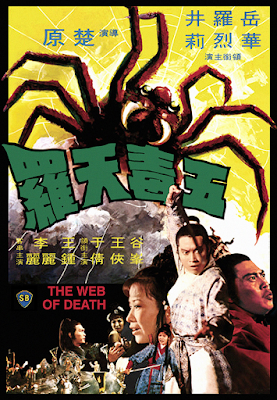
#9 Web of Death (1976) - Prime
Categories: Powerful Item, Intrigue, Martial Arts Contest
Pre-gen Characters Required: No
Suggested Game Style: Sandbox
This classic movie revolves around a common wuxia trope that perfectly fits the Jianghu we created for RBRB. Competing interest groups are trying to acquire a powerful item, while at the same time, an important martial arts contest looms on the horizon. In the movie, the powerful device is a magical spider, the powers of which are similar to one of the Top Ten Weapons in Righteous Blood, Ruthless Blades, namely, the Mother of Lightning. Essentially, it's a device that can massacre large numbers of opponents. In the movie, a villainous member of the Five Poisons Clan wants to use the device to slaughter the righteous sects, who are planning the martial arts contest to decide who will lead the martial world. In replicating this adventure, the GM could have the players be members of any of the various factions. Plan events to start out similarly to the plot of the movie, but be prepared for the players to take the story in a different direction.
Advice: Let the players' actions determine how events ultimately play out. Some movie elements, such as the romantic subplot, would be difficult to pull off and should probably be avoided. That said, the romantic element could be an amazing twist if you have players that are inclined to form romantic relationships with NPCs.
**

#8 The Duel (2000) - Prime
Categories: Mystery, Investigation, Martial Arts Contest
Pre-gen Characters Required: No
Suggested Game Style: Sandbox
This China Summer Blockbuster (well, it was really a Chinese New Year Blockbuster, but same idea), is based on a classic Gu Long novel featuring the wuxia detective Lu Xiaofeng. As the "duel of the century" approaches, Lu Xiaofeng investigates mysterious goings-on in the capital city and its surroundings. Of course, there's a shocking conspiracy to be rooted out. At the same time, a frenzy develops regarding the upcoming duel, and bets are being placed left and right, with all the shenanigans you might imagine. Running a one-shot based on this movie would be on the challenging side, as the GM would have to take a lot of care in planning out the clues, key events, plot twists, etc.
Advice: Draw primarily on the general plot idea and key events/clues/schemes, with less focus on trying to replicate the protagonist's actions in the movie.
**

#7: The Fate of Lee Khan (1973) - Blu-ray - DVD - Prime (Rentable)
Categories: Assassination, Intrigue, Isolated Location
Pre-gen Characters Required: Maybe
Suggested Game Style: Sandbox
This King Hu classic is the perfect material for an assassination adventure. The assassins arrive separately at a remote inn in advance of their quarry, giving them time to make plans and meet up with allies. Tensions mount as enemy agents also arrive in advance, and plot twists occur, leaving the audience wondering if the plot will be pulled off successfully. For the most part, the antagonists and main plot beats could be lifted directly from the movie and used in an adventure. Having pre-generated characters for your player would be ideal, as you could create a team of assassins with varying skills and abilities that are intended to be used in different aspects of the job. However, player-generated characters could work just as well.
The Dragon Gate Inn series of movies (the first of which was also directed by King Hu) is similar to The Fate of Lee Khan, except that they involve the protagonists holing up in the remote inn while facing external threats, as they prepare to flee the country. To one extent or another, all of the various versions could be ported into one-shots.
Dragon Gate Inn (1967) -Blu-ray - DVD - Prime - YouTube (Rentable)
New Dragon Gate Inn (1992) - DVD
Flying Swords of Dragon Gate (2011) - Blu-ray - DVD - Prime
Advice: Make sure to stick with the "remote inn" aspect. I once planned a complex adventure based on The Fate of Lee Khan, but made the mistake of setting the inn right in the middle of a big city. The players immediately derailed all of my plans, and the adventure turned out nothing like the movie (it was still a blast, just not what I had initially planned). Having the players isolated in the remote wilderness or frontier will make the scenario easier to manage. It will also be easier to replicate the mounting tensions as mysterious individuals arrive at the inn, and plots are hatched.
**

#6: Killer Constable (1980) - Blu-ray - DVD - Prime
Category: Mystery, Bloodbath, Traveling
Pre-gen Characters Required: Maybe
Suggested Game Style: Linear
This gritty and violent film follows one of China's top constables as he tracks down thieves who robbed the imperial treasury. As you might expect, there's a big twist in the end. The most relevant aspect of the movie is the ruthless personality of the protagonist, which makes this a great candidate for pre-generated characters. If the players are willing, they could even form a team of merciless constables who follow the general philosophy of the movie's main character, which is basically "kill all lawbreakers". Regardless of how you handle the characters, the main plot hook and the various twists and turns can be easily duplicated in a one-shot session. For the most part, the plot follows the structure of: 1) Travel to next location 2) Uncover clue. 3) Fight. 4) Back to 1. Because of the fairly linear nature of the plot, the GM will need to exercise caution to avoid railroading the players.
Advice: Make sure the players have plenty of opportunities for bloodshed in the form of weak NPCs who can easily be defeated in waves. That said, make sure to emulate the desperate nature of many of the combat scenes. And if possible, have a major "darkest moment" replicating how the main character ends up in a no-win situation and is severely wounded.
**
In the next installment, I'll get into my "top 5 wuxia movies that can be converted into one-shots," including a few that were released in recent years. Check it out here!
Saturday, December 19, 2020
Challenges for GMs in Righteous Blood, Ruthless Blades
All game systems come with unique challenges, and Righteous Blood, Ruthless Blades is no exception. In this article, I will talk about a few aspects of the game that could be difficult for a GM to deal with if they arise unexpectedly. Please note that these are my personal musings, and don't reflect the opinion of Osprey or my co-author Brendan Davis.
**
Challenge: Perfectly Matched Opponents
Background: Because of the vast number of combinations possible when it comes to Signature Abilites, Counters, Weapons, etc., and when you throw in the ramifications of Resist, its feasible for two opponents to be so evenly matched that they can't hit each other, or at least, can't damage each other. Although our primary goal for RBRB was for combat to be fast and gritty, the idea of two opponents being perfectly matched is actually a common genre trope. If you've watched or read much wuxia, you've surely encountered this classic plot element. Below is a scene from Brotherhood of Blades (2002) in which one character can't beat another because of lacking training in certain moves (keep an eye on the subtitles to pick up on that point).

Solutions: If a fight breaks out and a few rounds pass in which no one is hit or injured, and it seems likely to continue that way, have the NPC attempt to end combat and start a conversation. If the PCs refuse to allow that, allow for a "cut scene" to occur mid-combat. Either way, have the NPC issue a challenge to the player(s) to meet again for a duel at a later date (presumably allowing the NPC time to train and reach a higher level, acquire a more powerful weapon or Signature Ability, or hatch some plot to win, possibly in an underhanded way). Of course, this will also give the PCs plenty of time to prepare as well. Make sure the time and place of the duel are formally agreed upon. Maybe even have the participants swear an oath. If there were witnesses present, allow them to spread the news. Or perhaps the antagonist can announce the duel to the Jianghu; this ensures that, if the PCs renege, they will lose face and become a laughingstock. The duel could take place the following month. It could be in a year or even ten years. It all depends on the situation. This sort of challenge is commonly seen in wuxia. Not every on-screen example is perfectly analogous, but the concept can be found in films such as Magic Blade (1976), Crippled Avengers (1978), or Reign of Assassins (2000), or Jin Yong's classic novel Legend of the Condor Heroes.
**
Challenge: Uniquely Specific Signature Abilities, Counters, Weapons
Background: Many of the Signature Abilities, Counters, Weapons, etc. in the game are only useful in very specific circumstances. For instance, Meridian Transposition is only helpful when fighting opponents with Internal Arts or acupoint attacks. Engulfing Wings of the Night Sky only defends against ranged attacks. And Fan of Dragon's Breath is essentially useless unless used against multiple opponents. In all of these cases, it would be simple, intentionally or by accident, to completely nerf a player character. In a scenario in which the players infiltrate a clan that only uses External Arts, a player with Meridian Transposition would quickly be frustrated by the fact that their main character's hook is pointless. If that clan only fights with melee weapons, and the character uses Engulfing Wings of the Night Sky, they would be even more ineffective. And if the character's weapon is Fan of Dragon's Breath, and every encounter features a single opponent, they might feel so useless they would rather create a new character for the scenario. Because Righteous Blood, Ruthless Blades does not allow for players to build up a huge catalog of martial arts skills, the tools at their disposal are often limited.
Solutions: There are different schools of thought in RPGs regarding how GMs should set up encounters, adventures, and campaigns. Some believe that in-game scenarios should be created without consideration for the player characters' specific talents, abilities, etc, lest the game seem contrived. Although I generally agree with this, in wuxia, there is a huge emphasis on dramatic plot twists and unexpected, exciting developments. Further, the character-driven nature of the stories usually involves the protagonist(s) having or developing some sort of unique advantage over their opponents. Because of this, my philosophy for RBRB is that GMs should cater at least somewhat to the player characters. Allow players to emulate those exciting moments from wuxia stories in which the protagonists' abilities allow them to pull off a "plot twist" on the NPCs.
For example, in the above scenario, perhaps this clan of External practitioners has hired an Internal Arts master as a bodyguard or enforcer. Maybe they have powerful weapons that target meridians, or set up some traps with flying darts. Maybe their headquarters has a room populated by sleeping guards that could result in a larger melee battle.
This concept is key to wuxia. For instance, in the novel version of Gu Long's Heroes Shed No Tears, the protagonist's understandings of the secret function of a powerful weapon, and the antagonist's lack of understanding, plays a key role in one of the biggest twists in the novel. And in the classic One-Armed Swordsman (1967), the protagonist's new martial arts ability perfectly takes advantage of a weakness in the enemy's special weapon, allowing for a dramatic comeback in Act 3 of the movie. See below for a taste.

**
Challenge: Problems with Fire Deviation Eccentricities
Background: In my experience, Fire Deviations can be one of the most entertaining aspects of the game. However, a few challenges can arise with them.
The first comes with players who intentionally accumulate a lot of them. For instance, a player might put 0 points into Meditation, ensuring that they almost always fail to level up without experiencing Fire Deviation. On top of that, they can then exercise their right to intentionally experience Fire Deviation to gain additional Signature Abilities. The result can be a player with multiple Fire Deviations, (as many as 12 if my math is correct). Many times, this will result in them acquiring numerous roleplay-centric Eccentricities that are conflicting or, at the very least, difficult to manage simultaneously. For instance, what if a player who has a fear of blood develops the requirement of drinking five catties of human blood daily? What happens if the character becomes chivalrous and honor-bound, but at the same time, develops the obsession to kill an innocent person once a month? Granted, roleplaying such conflicted characters could be great fun for some people, but for others, it could be so difficult as to drain any fun out of the game.
The second challenge is that some Fire Deviation Eccentricities require significant work on the side of the GM. For instance, to effectively include nightmares or hallucinations in a meaningful way will take even an experienced GM a good amount of forethought and preparation. And other Eccentricities that might not be in the control of the GM will require the GM to react quickly and realistically to what could be very erratic or even crazed behavior. For example, what if your campaign is intrigue-heavy and has the characters infiltrating the imperial palace, but then your party's Internal Arts expert acquires the Mental Affliction that turns them into a murderous beast if they use Internal?
Solutions: My first suggestion is to discuss this subject with your players before starting your campaign. If you're an experienced GM playing with experienced players, you might let the sky be the limit and just see what crazy characters your players end up with. But if you're a less-experienced GM with newer players, you might want to put some limitations in place. For example, you could institute a house rule that players must put at least one point into Meditation if they plan to add additional Signature Abilities by taking Fire Deviations. Or you could create limitations to how many Mental Afflictions are allowed (these are generally the ones that involve skill with roleplaying and acting). Although there is a rule to re-roll Fire Deviations that don't make sense, you might also want to define how strictly you plan to apply that rule. Regardless of the specific way you handle your in-house rules, it's best to consider the issue and come up with a plan before jumping into a campaign.
A secondary suggestion is to arrange your sessions so that leveling up (and by extension acquisition of Eccentricities) happens at the end of game sessions, or between sessions if you want to skip the excitement of the Meditation rolls. Either way, avoid leveling up at the beginning of a session, as whatever planning your put into the game could be thrown out the window if a player acquires the right (or wrong) Fire Deviation.
For inspiration regarding Fire Deviations, you could check the many incarnations of Jin Yong's Return of the Condor Heroes, in which the antagonist from Legend of the Condor Heroes, Ouyang Feng, returns having gone insane after practicing a powerful martial art incorrectly. Another great depiction of a psychotic martial artist is in the wuxia horror flick Human Lanterns (1982). Although the character is the antagonist, and isn't explicitly said to have gone insane because of Fire Deviation, the legendary Lo Lieh does a great job at portraying a mentally deranged wuxia masked killer. See below for a taste... if you dare.

**
If you don't have the game already, you can pick it up on Osprey's website, DriveThruRpg, Amazon, or just about anywhere else that sells books. As usual, feel free to reach out to me if you have questions or comments, my social media links are at the bottom of this page. For more information about me and my work, check out my website.
Wednesday, November 25, 2020
Check out the Righteous Blood Podcast!
We just celebrated the release of the tenth episode of the Righteous Blood podcast, in which we talk about the mechanics and inspiration of Righteous Blood, Ruthless Blades. You can get all sorts of background information, behind-the-scenes details, easter eggs, and more in the podcast, so if you haven't checked it out, see the links below.


Episode 1 - Grudges, maiming, OP characters, and specialty weapons (referencing One-Armed Swordsman and Crippled Avengers).
Episode 2 - Romance, magic, and grudges (referencing Bride With White Hair and Bride With White Hair II)
Episode 3 - Top Ten Weapons and Fighters, Eccentricities, Face (referencing Human Lanterns and Magic Blade)
Episode 4 - Signature Abilities, magic, and dungeons (referencing Lady Hermit and Web of Death)
Episode 5 - Magic, escort companies, encounter tables, and more (referencing Reign of Assassins and Magnificent Bodyguards)
Episode 6 - Ruthlessness and morality, combat phases, dialects, and more (referencing Killer Clans and Dragon)
Episode 7 - Eccentric characters, romance and heartbreak, shifting loyalties, NPC networks, death and dying (referencing Jade Dagger Ninja/Shaolin Fox Conspiracy)
Episode 8 - Linear adventures for GMs, "drunken" characters, and a host of other random things (referencing The Kid with the Golden Arm)
Episode 9 - Bringing horror elements into wuxia campaigns, and other sundry topics (referencing Finger of Doom)
Episode 10 - Destiny Paths, the nature of duels, transferring wuxia into an RPG (referencing Death Duel).
Monday, October 5, 2020
Alcohol, Wine, Baijiu, and Drinking
Some background about the cultural and genre inspiration for Righteous Blood, Ruthless Blades.
The drinking of alcohol plays an important role in Chinese culture, and it has for thousands of years. It’s especially prominent in the wuxia genre. For that reason, we included mechanics governing alcohol consumption in Righteous Blood, Ruthless Blades, including Signature Abilities related to drinking. However, the way drinking is portrayed in classic wuxia differs slightly from how it’s perceived by many in the gaming community, at least as it relates to kung fu and Chinese martial arts. Specifically, in my observation, there is a considerable emphasis on ‘drunken boxing’ or ‘drunken fist.’
‘Drunken boxing’ is a real-life type of martial art that imitates a drunk person’s movements. In my opinion, its popularity in Western media stems primarily from its portrayal in the 1992 Jackie Chan classic Drunken Master II. Of course, that was not the first time drunken boxing was portrayed on screen. Jackie Chan’s 1992 film was a loose followup to the original Drunken Master movie from 1978, and there are plenty of other movies that portray it. Although ‘drunken boxing’ does appear in other non-Chinese media before Drunken Master II (including Dragon Ball, Yu Yu Hakusho, and others), it wasn’t until the mid-1990s and later that it grew widely popular in the West. For instance, it appeared in Virtua Fighter 2 in 1994, in Mortal Kombat: Deadly Alliance in 2002, and in Jade Empire in 2005, to name a few. And it found its way into tabletop roleplaying games. For example, you can find it in the Everway supplement Spherewalker Sourcebook from 1996 or in the 2017 DnD 5e expansion Xanathar’s Guide to Everything, in which there is a Monk subclass literally called “Way of the Drunken Master.”
 |
| Artwork by Kagan McLeod |
That said, the idea of a martial artist who becomes drunk and then fights in a stylistically drunken fashion is not something incredibly common in wuxia. In fact, martial arts heroes are often portrayed as having an extremely high tolerance for alcohol. While they can get drunk, that doesn’t, by definition, improve or deteriorate their fighting ability (although it can do either depending on the whim of the author). Sometimes, the characters can become completely sober at a moment’s notice, making it questionable whether they were ever really drunk to begin with. For instance, here is a passage from an unofficial translation of Gu Long’s Sentimental Swordsman, Ruthless Sword, which I edited to improve readability.
In the above passage, the consumption of alcohol is tied to past emotional trauma. But there are plenty of examples in wuxia stories where there is no negative stigma attached to drinking and getting drunk. For instance, here’s a clip from the 2008 TV drama version of Jin Yong’s classic Legend of the Condor Heroes. In this scene, the Seven Freaks of Jiangnan compete with the Daoist priest Qiu Chuji in drinking.Some people say that ‘when you drink to ease distress, you only cause more distress.’ That's not entirely accurate. A small amount of wine can make one remember more of the past, including more painful memories. But when a person becomes truly drunk, then they will forget everything.
Li Xunhuan knew that, so he drank as if his life depended on it.
It’s usually not hard to get drunk. But when a man has enough problems, he will drink more often than an average person. Then, when the time comes that he absolutely needs to get drunk, he won’t be able to.
The sun had long since set, and the night was dark.
Li Xunhuan had consumed a lot of wine, but didn't show even a hint of being drunk.
He suddenly realized that no one else in the room was drunk either. Almost twenty people had been drinking this entire time, yet none of them were drunk. It was definitely unusual.

Seeing that even after 28 bowls of alcohol Qiu Chuji was still looking sober and normal, the Seven Freaks were quite shocked….
Quan Jinfa calculated that his side still had five participants left, each a heavy drinker who could probably drink for three or four more rounds. Their opponent couldn’t possibly hold another twenty or so drinks in his belly, or could he? Even if he really was incapable of getting drunk, his belly could only hold so much.
To emulate this wuxia trope, characters in Righteous Blood, Ruthless Blades have a Drinking Limit that governs how much alcohol they can consume. If they surpass that limit, they must make a Drinking skill roll. Succeed, and they can continue to drink alcohol past their limit. If they fail, they pass out. Other related mechanics go along with alcohol consumption, including various bonuses and penalties, but I won’t detail them here. Suffice it to say, alcohol can play a significant role in the game if the GM wishes to emulate Chinese culture and the wuxia genre in that way. There are many details provided in the sourcebook regarding Chinese drinking culture and how players and GMs can use it in the game.
Of course, there is no universal rule for how alcohol works in a wuxia setting; different authors handle it differently, and even individual authors can change how they use it from novel to novel.
Something else to consider is the type of alcohol being drunk. The character for alcohol (酒) is often translated as “wine,” but that can be deceiving, as 酒 covers all types of alcohol, including beer, grape wine, distilled liquor, and a host of other alcoholic beverages, including Chinese varieties that aren’t common in the Western world. In wuxia settings, the “wine” mentioned would likely not be grape wine unless specifically said to be, as grape wine has only become a common beverage in China in recent years. In most cases, the alcohol consumed in wuxia settings would be either yellow wine or baijiu.
Of course, there is no universal rule for how alcohol works in a wuxia setting; different authors handle it differently, and even individual authors can change how they use it from novel to novel.
Something else to consider is the type of alcohol being drunk. The character for alcohol (酒) is often translated as “wine,” but that can be deceiving, as 酒 covers all types of alcohol, including beer, grape wine, distilled liquor, and a host of other alcoholic beverages, including Chinese varieties that aren’t common in the Western world. In wuxia settings, the “wine” mentioned would likely not be grape wine unless specifically said to be, as grape wine has only become a common beverage in China in recent years. In most cases, the alcohol consumed in wuxia settings would be either yellow wine or baijiu.
In Righteous Blood, Ruthless Blades, we made baijiu the drink of choice for a few main reasons. First, baijiu is far and away the alcoholic beverage of choice in today's China, and we wanted to create a thematic connection to modern gamers. Second, the famous wuxia author Gu Long was a big fan of liquor, and we sought to pay homage to him. The third reason is more personal. One of the earliest contributors to the game was my cousin-in-law Guo Feng, a wuxia fanatic that I would consider an unofficial ‘wuxia expert.’ He was deeply familiar with the works of all the prominent wuxia authors, and provided a considerable amount of very helpful input. He was also an enormous fan of baijiu. Some of my fondest memories of time spent with extended family in China are of drinking baijiu with him while talking about the works of Jin Yong, Gu Long, and other famous novelists. Sadly, Guo Feng passed away in 2019, long before he could ever see Righteous Blood, Ruthless Blades in print. Although I don’t mention it in the book, our collection of unique varieties of baijiu provided in the rules is also an homage to him.
As for Gu Long, he would even mention specific brands of alcohol in his works. For example, here’s a passage from Dragon King with Seven Stars.
As for Gu Long, he would even mention specific brands of alcohol in his works. For example, here’s a passage from Dragon King with Seven Stars.
Guizhou Maotai is arguably the most famous baijiu brand in modern China, albeit somewhat of a modern one. In Dragon King with Seven Stars, Gu Long mentions several other brands of baijiu, as well as some specific types of yellow wine and even imported beverages such as Persian wine.Four more beautiful women, dressed like the others, came in carrying a leopard skin stretched between two bamboo poles. On the leopard skin was a jug of alcohol.
The loud, clear voice again called out: “Twenty-year-old Guizhou Maotai!”
Smiling, the four women placed the Maotai down in front of Ingot.
Technically speaking, the inclusion of baijiu could be anachronistic, depending on the time period of your campaign or adventure in Righteous Blood, Ruthless Blades. Some sources indicate that alcohol was being distilled as far back as two thousand years ago in China. However, it probably wasn’t until about a thousand years later in the Song Dynasty that baijiu became a common beverage. And it probably wasn’t until hundreds of years later that distillation technology reached the point of producing beverages like those consumed today, with a high percentage of alcohol by volume. In other words, if you want your game to take place in a specific historical setting, you might want to do further research to maintain accuracy. A historically accurate campaign set in the Tang or Han dynasties, or the Three Kingdoms or Warring States periods, might not have baijiu in the setting at all.
That said, we encourage a more anachronistic approach in Righteous Blood, Ruthless Blades, which is intended to fit any time period in Chinese history, and any general region within China. And historically, anachronisms are common in wuxia novels and movies, so gamers shouldn’t feel compelled to focus too much on accuracy.
In keeping with the anachronistic flair of wuxia, we include a collection of extraordinary and fictional types of alcohol in the sourcebook. For groups wishing to have historically accurate games, some additional research will go a long way in making that happen. And for those groups who don’t care about historical accuracy, you will have a great time just picking up the game and running with it.
As usual, if you have any questions or comments, please reach out to me via the social media links listed at the bottom of the page. For more information about me, check out my website. And if you haven't already, make sure to preorder the game now!
For those of you who have read to this point, I will leave you with a great clip from the wuxia cult favorite Kid with the Golden Arm, featuring one of the greatest ‘drunken’ wuxia heroes of all time, the imperial constable Hai Tao.

Monday, September 28, 2020

Saturday, September 19, 2020
Leveling up, meditation, and Fire Deviations
Righteous Blood, Ruthless Blades is a darkly themed wuxia roleplaying game. Our vision for the game was for both NPCs and player characters to be able to emulate the unique and eccentric characters that often appear in the wuxia genre, especially the works of Gu Long. He creates heroes and villains who stand out from the crowd and make an impression in the reader's mind. For instance, check out the following character introduction from his novel The Eleventh Son. Despite having read this novel about fifteen years ago, I've always remembered this particular character, who is actually just a minor villain.
When [the fourth man] emerged, everyone was taken aback. His appearance was bizarre. He was less than five feet tall, but he had a massive head with disheveled hair. His shaggy eyebrows were so thick they almost merged. His left eye glistened like a bright star, but his right eye was as ashen as a dead fish's. His bushy mustache covered a blood-red mouth. His right arm was severed at the shoulder, but his left arm was so long it almost touched his toes....
Some of the spectators had guessed the identity of this man. [He was]... the One-Armed Hawk King!
To encourage players to create unique and eccentric characters, we included an Eccentricities phase during character creation. For the most part, the initial Eccentricities are for flavor purposes and don’t affect the characters mechanically. In this way, players can create classic wuxia trope characters such as a one-armed swordsman or a blind beggar without having to worry about being hamstrung mechanically. However, it is also possible to acquire eccentric characteristics during gameplay, which do have mechanical weight or roleplaying implications. It can happen because of being maimed in combat, or by intentionally pushing beyond one's limits to learn more martial arts than is considered safe and healthy.
Another way it can happen is by making mistakes when leveling up. When characters meet the requirements to rise in level, they must meditate for a number of days equal to the level being entered. In other words, a character going into the second level would need to meditate for two days, while going into the third level takes three days, and so on. Each day, the character must make a successful Meditation skill roll to proceed to the next day. When all of the successful Meditation rolls have been made, the character rises to the next level. However, if the character fails three successive Meditation roll attempts, their session of meditation is aborted, and while they are still allowed to rise in level, they also experience Fire Deviation.
Fire deviation (走火入魔 zouhuo rumo) is a real-life term and a complicated topic in general. In fact, I devoted an entire YouTube video to it, explaining the etymology, history, etc. There is also a rather lengthy Wikipedia article about it, although that article focuses on real-life explanations and doesn't get into how the term is portrayed in wuxia. There are different ways to translate 走火入魔, but “fire deviation” has been used in wuxia movies and novels for many years, so we chose to go with that version. In a nutshell, fire deviation is when someone makes a mistake made in meditation, martial arts, internal energy cultivation, etc. It’s something that is often mentioned in wuxia, but isn't frequently depicted on-screen or in the narrative. It’s more common to hear people talking about it after the fact, or worrying about the possibility of it happening. In some cases, people who suffer from it are described as being sick or crippled. Here’s a passage from Gu Long's 7 Killers, describing one of the most powerful martial artists in the Jianghu of the novel.
Dragon Fifth sat on the restaurant’s upper floor, in an elegant private room on a wide bench. His face was pale white, his body thin and haggard, and in his eyes, he carried unspeakable exhaustion. He looked to be not only tired, but also physically weak, even sick....
Perhaps he had some congenital condition, or perhaps he had experienced fire deviation when practicing martial arts. In any case, he’d acquired some strange illness, and it tormented him like maggots gnawing on his bones.
Sometimes, though, fire deviation is described as providing increased strength and power, or perhaps supernatural or superhuman abilities, although generally along with negative consequences. For instance, check out this scene from the 2017 Ode to Gallantry television show (based on the Jin Yong novel of the same name), in which a villain experiences fire deviation in the middle of a fight scene. Although Righteous Blood, Ruthless Blades doesn't allow for fire deviation in combat, it is possible to gain enhanced abilities or powers because of it.

In Righteous Blood, Ruthless Blades, gaining a Fire Deviation involves both mental and physical consequences. The player will roll on a set of extensive nested tables to determine which afflictions they experience. Some have mechanical weight in gameplay. For example, on the mental side, you might be struck with amnesia and be forced to make a Reasoning skill roll to remember anything. On the physical side, your hands might turn into twisted claws that do extra combat damage. Other Fire Deviations are more geared toward roleplaying. For example, on the mental side, you might believe yourself to be an animal or inanimate object in human form. On the physical side, your throat could be damaged, forcing you to speak in a raspy voice. There are some Fire Deviations that have no weight at all, such as developing glowing eyes or having your teeth fall out.
In our playtesting, leveling up and Fire Deviation were some of the most enjoyable and entertaining aspects of the games. Making meditation attempts, and either narrowly avoiding Fire Deviation, or ultimately experiencing it, was just very fun. And of course, the process of gaining the new Eccentricities and having one’s character transform into a bizarre and unique martial arts expert can be a blast. Take a look at this artist's depiction of my own playtest group, courtesy Xiaofanchuan. These are all high-level characters, most of whom picked up at least one or two Fire Deviations along the way, and one of whom accumulated over ten. If you look closely, you can see things such as claws, veiny skin, a third eye, glowing marks, etc. And that's not to mention the mental Fire Deviations.

I do have a few bits of advice for GMs and players regarding leveling up. It is highly advisable for any players who do not want their characters to change physically or mentally to have a high Meditation skill. In playtesting, there were some players whose characters ended up with few or even no Fire Deviations at all, thanks to having a high Meditation skill and succeeding on their rolls when leveling up. On the other hand, players who like the idea of their character slowly becoming eccentric or even mad, much the same way characters tend to do in games like Call of Cthulhu, or developing bizarre or enhanced physical characteristics, can simply refrain from putting any points into Meditation. Because the number of successful rolls required increases by level, the chances of failure also increase. On a mechanical level, the extent to which Eccentricities are part of the game is largely up to the players.
It should be noted that some of the Fire Deviations require a higher-than-average level of skill either for the player or the GM. For example, some lead to changes in personality. And more than one involves experiencing hallucinations or delusions that are controlled by the GM. Suppose a playgroup has newer players, or perhaps players who don’t like heavy roleplay, voice acting, etc. In that case, the GM might consider letting them re-roll if their result requires extensive skill or experience in roleplaying. And a GM who does not feel comfortable managing complicated GM-involved versions should consider skipping those.
Suffice it to say, I found meditation, leveling up, and Fire Deviations to be one of the most entertaining aspects of the game. Furthermore, they provide fantastic possibilities for character growth, and can be a delight for players who enjoy playing the role of interesting, unique, and distinctive characters. As usual, if you have any questions or comments, please reach out to me via the social media links listed at the bottom of the page. For more information about me, check out my website. And if you haven't already, make sure to pre-order the game now!
Subscribe to:
Posts (Atom)